
Two Similar Problems That Break Execution in Very Different Ways
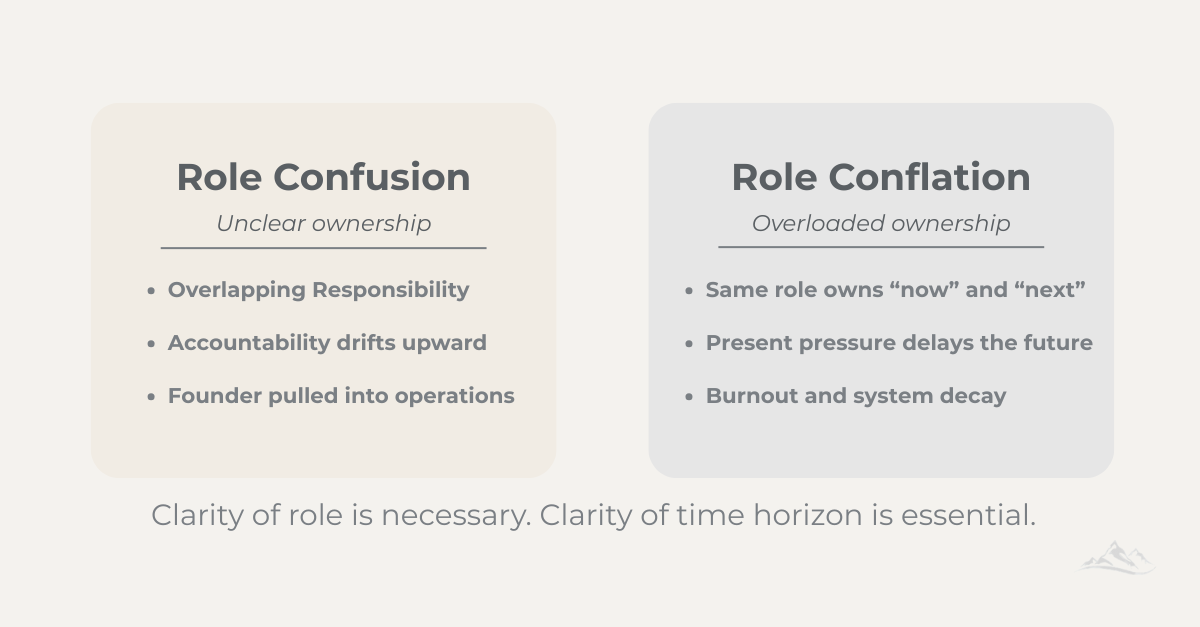
In recent posts, we’ve talked about role confusion — when people aren’t clear on who owns what.
But even when role confusion is addressed, organizations still stall.
Not because people don’t care.
Not because leaders aren’t trying.
But because of something easier to miss: role conflation.
The difference matters — especially when aligning accountability to real goals.
Organizations don’t stall because people don’t care.
They stall because something easier to miss is happening.
Two stories help make that distinction clear.
When Buying More Made Things Worse
During the pandemic, lead times stretched and inventory became unpredictable.
Stockouts started showing up, and pressure built around purchasing.
The reaction felt reasonable and was pushed from the top:
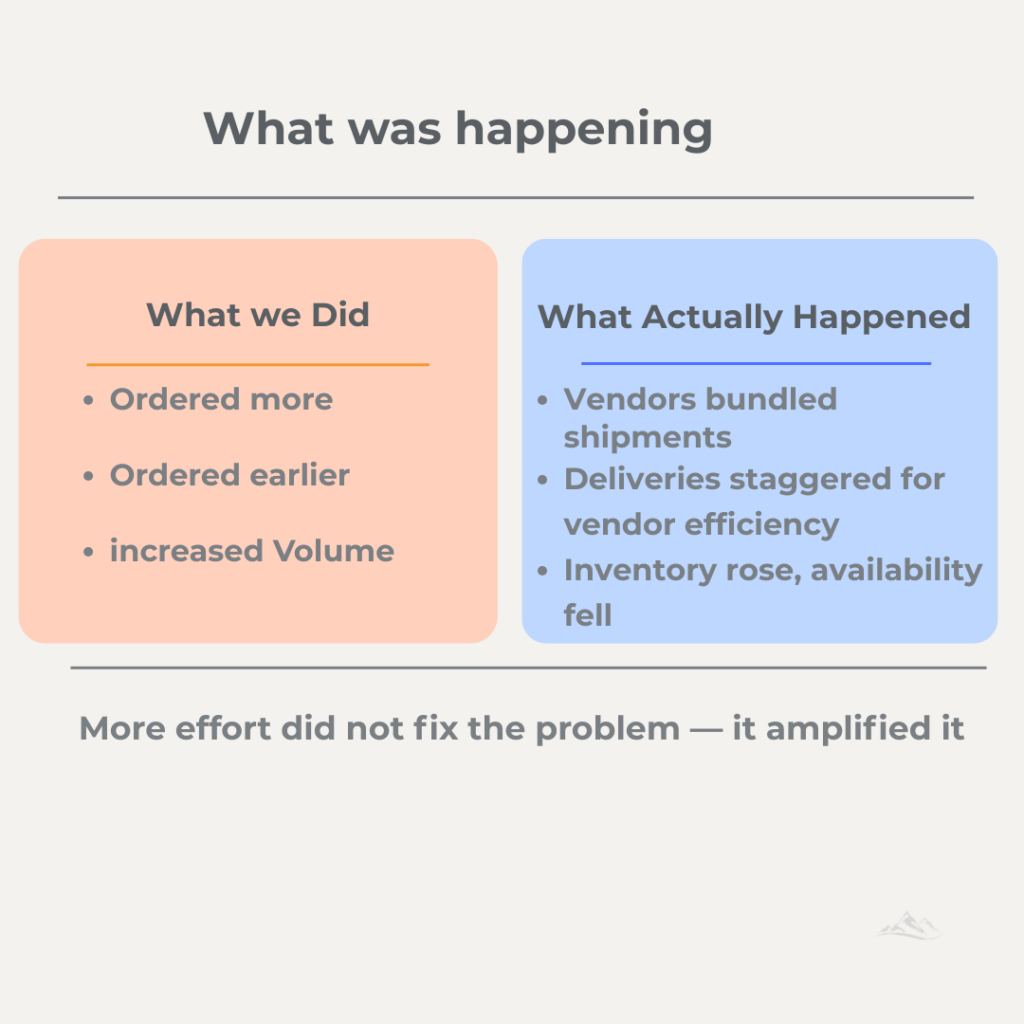
“Order more. Order earlier.”
So we did.
Inventory went up.
Stockouts got worse.
Service levels dropped.
Vendors weren’t being difficult—they were being rational. Bigger orders caused them to group shipments, stagger deliveries, and bundle urgent and non-urgent items together.
Inside the business, everyone was busy—but no one clearly owned stepping back to manage the whole flow.
That’s role confusion.
People are trying to help, but ownership of the real problem isn’t clear.
What fixed it wasn’t more pressure from the top.
It was clear accountability at the level of the work—one person owning priorities, separating urgent from non-urgent orders, and communicating clearly with vendors.
Once ownership was clear, flow improved.
A System Change That Bound Everything Up
Later, during a system change, a different problem showed up.
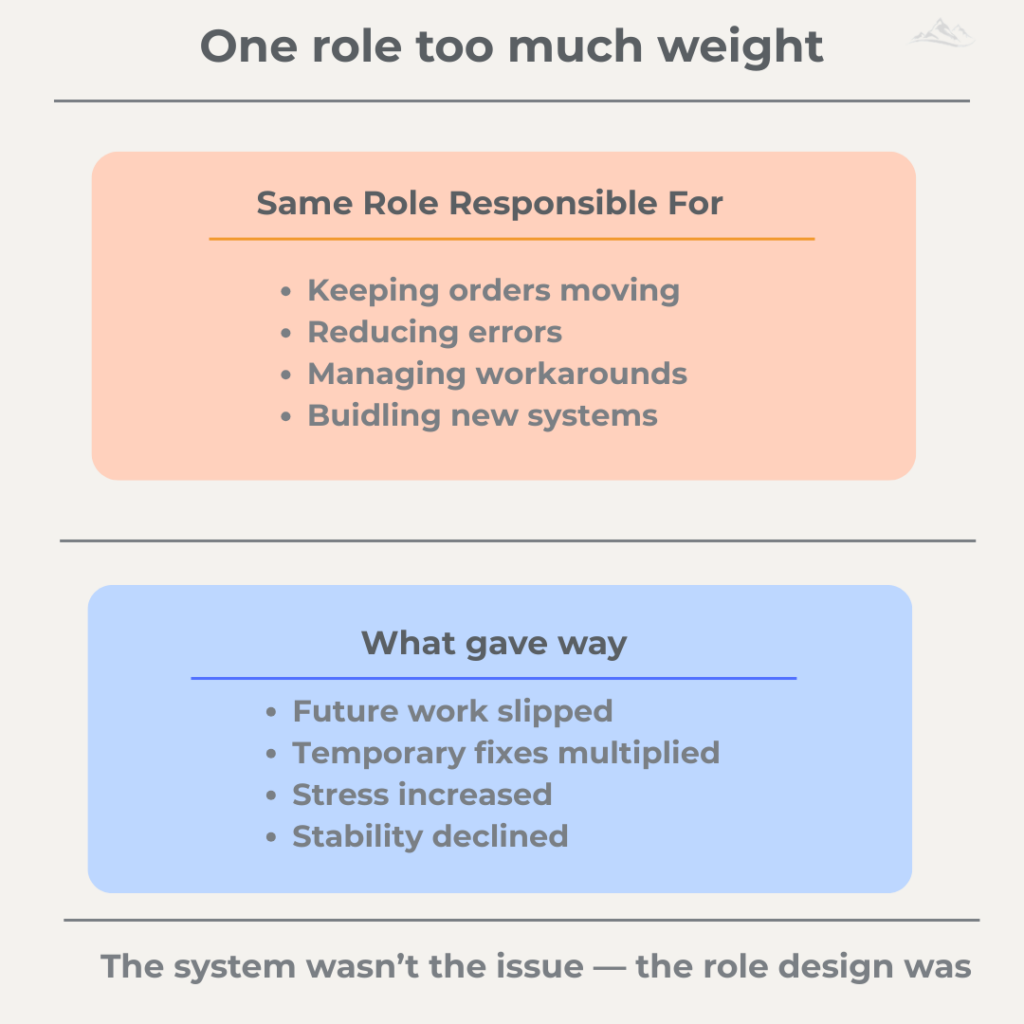
The same people running day-to-day operations were also asked to:
- Handle system changes
- Manage workarounds
- Clean data
- Keep customers happy
Nothing came off their plate.
When pressure increased, the future work slipped:
“We’ll fix this once the new system is live.”
That’s role conflation.
Ownership was clear—but stretched across today and tomorrow at the same time.
What worked was separating accountability:
- One leader focused on keeping current operations stable
- Another focused on getting the new system live
Customers were better served now, and the future kept moving.
Why These Problems Get Mixed Up
Role confusion and role conflation feel similar because they produce similar symptoms:
- Missed commitments
- Frustrated teams
- Leadership intervention
- Burnout
But they are different problems.
Role confusion happens when:
- Ownership is unclear
- Accountability overlaps
- Decisions drift upward
Role conflation happens when:
- Ownership is clear
- But stretched across incompatible time horizons
- With no separation of capacity, metrics, or cadence
Role confusion asks: Who owns this?
Role conflation asks: Can one role realistically own all of this?
The Leadership Design Insight
Both failures share the same root cause:
Accountability wasn’t aligned to the nature of the work.
Some work stabilizes the present.
Some work builds the future.
They require different rhythms, incentives, and decision rules.
When leaders fail to separate them:
- Effort increases
- Results degrade
- And people absorb structural pressure personally
That’s when good leaders start “doing more” — and accidentally make things worse.
The Shift That Changes Outcomes
The solution isn’t intensity.
It’s design.
- Clear ownership to eliminate role confusion
- Clear separation by time horizon to prevent role conflation
- Explicit tradeoffs instead of implicit overload
When accountability is designed correctly:
- Flow improves
- Systems transitions succeed
- And leaders stop being part of the amplification loop
A Quiet Bridge Forward
These stories are also why ideas like flow, constraints, and system behavior matter so much in operations. Frameworks like the Theory of Constraints don’t just optimize processes — they help leaders see where structure is causing pressure to amplify instead of resolve.
If there’s interest, we can go deeper into how TOC fits into all of this.
Closing Thought
Role confusion breaks execution by blurring ownership.
Role conflation breaks execution by stretching ownership across time.
Both are common.
Both are understandable.
Both are fixable — once they’re named.
Leave a Reply